
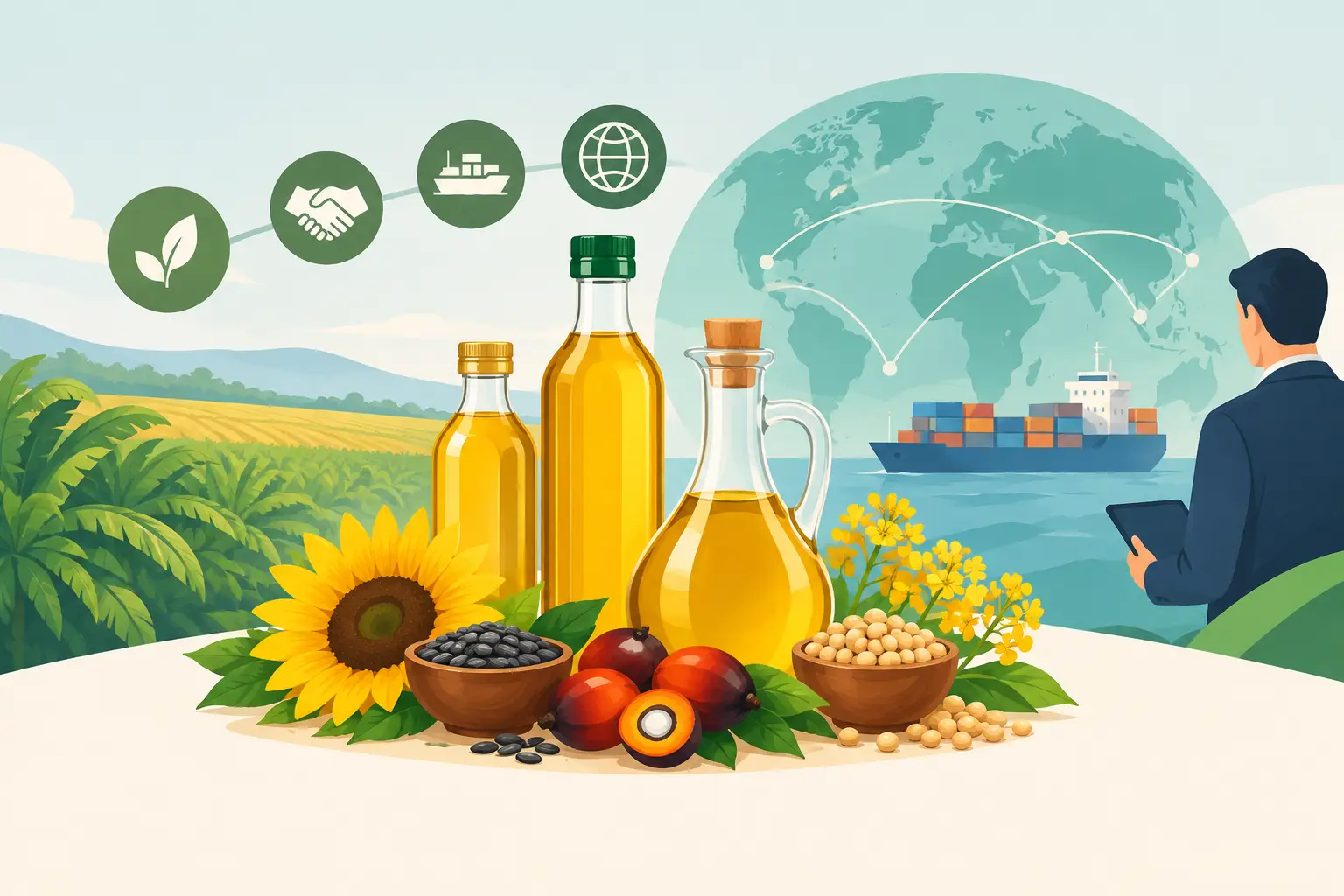
A delivered-cost quote can look competitive until the first delayed vessel, specification dispute, or documentation gap turns a low purchase price into a supply problem. Edible oil sourcing trends 2026 are pushing procurement teams to evaluate more than price per metric ton. For importers, food manufacturers, and distributors, the working question is whether a supplier can consistently load the agreed product, provide complete documents, and support the required delivery schedule.
Sunflower oil remains a major consideration for buyers seeking a neutral-tasting vegetable oil with broad food manufacturing and commercial applications. Ukraine’s role in sunflower cultivation and processing keeps origin assessment central to purchasing decisions. At the same time, buyers are treating origin as one part of a wider qualification process that includes production capability, quality systems, logistics readiness, and commercial discipline.
Edible Oil Sourcing Trends 2026: What Is Changing
The defining change is not a move away from global sourcing. It is a move away from single-factor sourcing. Buyers that once selected suppliers primarily on price and nominal capacity are placing more weight on execution evidence. They want to know which facility produces the oil, how lots are identified, which quality documents accompany each shipment, and what happens when a vessel schedule changes.
This is especially relevant for bulk edible oils, where a small variation in free fatty acids, moisture and volatile matter, color, odor, or packaging condition can affect production planning downstream. The appropriate standard depends on the intended use. A refiner, bottler, snack manufacturer, and foodservice distributor may all buy sunflower oil, but their specifications, shipment sizes, and tolerance for variation are not identical.
Procurement teams should therefore separate a supplier’s general market presence from its ability to meet a specific program. A producer with a defined product range and established plant operations may be a stronger fit than a trading offer that provides an attractive price but limited control over production, allocation, or lot documentation.
Supplier Qualification Is Becoming More Operational
In 2026, qualification is increasingly based on operating facts rather than broad supplier claims. Buyers are asking practical questions early in the process: Is the company a manufacturer or an intermediary? What oil types and grades does it produce? What is the normal lead time from contract confirmation to loading? Can it provide current specifications, certificates of analysis, and shipping documentation in the buyer’s required format?
For long-term programs, production history matters. It does not guarantee performance, but it provides useful evidence that a supplier understands crop cycles, plant maintenance, storage, export documentation, and commercial planning. EKOBIOTEK, a Ukrainian producer operating since 2003, reflects the type of manufacturer identity many buyers seek when evaluating sunflower and vegetable oil supply.
A site visit or third-party audit may be appropriate for larger annual volumes, private-label programs, or customers with strict food safety requirements. However, smaller buyers should not assume that an audit is the only form of verification. A clear production profile, current documents, responsive technical communication, and consistent sample performance can also provide meaningful information when assessed together.
Documentation Must Match the Purchase Order
Documentation issues often start with assumptions. A buyer may require a particular certificate, label statement, lot reference, or country-of-origin wording that was not specified before production or loading. Correcting those details at the port can create avoidable costs and delays.
The purchase order should state the agreed product name, grade, quality parameters, quantity tolerance, packaging format, Incoterm, destination, document set, inspection requirements, and claims or certifications required for the intended market. If the buyer needs refined, deodorized, winterized, or high-oleic oil, that requirement should be stated precisely rather than described informally.
Freight Planning Has Become a Sourcing Decision
Edible oil procurement is no longer complete when a contract is signed. Route availability, container positioning, port congestion, transit time, and destination handling can all change the delivered result. Buyers should assess logistics before committing to a sales schedule or manufacturing plan.
The right shipping structure depends on volume and destination. Flexitanks can be efficient for certain bulk container movements, while drums, IBCs, and bottled formats may fit distribution models that require smaller lots or different handling conditions. Larger parcel or vessel arrangements may improve freight economics at scale, but they also require stronger demand visibility and more careful inventory planning.
A lower ex-works or FOB price does not always create the best landed cost. Longer transit, higher demurrage exposure, re-routing risk, or destination storage constraints can outweigh an initial price difference. Procurement, logistics, and finance teams should review the same landed-cost model, using realistic transit and contingency assumptions rather than a nominal freight quote.
Build Time Buffers Around the Actual Supply Chain
Buffer stock should reflect the product’s criticality and the reliability of the route. A food manufacturer using sunflower oil in a continuous process may need a different coverage level than a distributor serving variable spot demand. There is no universal inventory target.
The practical approach is to map the time between forecast confirmation, production allocation, loading, transit, customs clearance, and delivery to the receiving location. Then identify where delay is most likely to occur. The purpose is not to hold unnecessary inventory. It is to avoid relying on a delivery date that leaves no room for normal operational variation.
Quality Control Is Moving Closer to Receiving Operations
Product quality remains fundamental, but buyers are paying closer attention to how quality is maintained from plant to destination. A compliant certificate of analysis is necessary, yet it should be supported by lot traceability, loading controls, packaging integrity, and a clear process for claims handling.
For bulk shipments, the buyer should agree on sampling and inspection procedures before shipment. The contract should establish whether testing is performed at origin, at destination, or both, and which method applies if results differ. This is not a sign of distrust. It is a practical way to reduce disagreement after the cargo has been discharged or incorporated into production.
Packaging requirements deserve the same attention. Flexitanks, drums, and IBCs should be suitable for the selected oil, route, and receiving equipment. A buyer may prioritize the lowest packaging cost, while a warehouse operator may be more concerned with unloading speed, handling safety, and disposal requirements. The correct choice depends on the full distribution model.
Commercial Terms Need More Flexibility
Price volatility and changing freight costs are encouraging buyers to use a mix of contract structures. Fixed-price contracts may be appropriate when demand, timing, and input costs are sufficiently clear. Formula-based pricing, staggered shipments, or defined pricing windows can be more suitable when the buyer needs volume coverage but wants to manage market exposure over time.
No structure eliminates risk. A fixed price can protect a buyer from an increase, but it can also leave the buyer above the market if prices decline. Shorter commitments can preserve flexibility, yet they may reduce allocation certainty during a tight supply period. The commercial choice should follow the buyer’s production schedule, inventory position, and tolerance for price movement.
Payment terms should also be aligned with the supplier relationship and shipment method. The goal is not simply to negotiate the longest possible credit period. It is to establish terms that support predictable production, document release, and cargo movement for both parties.
How Buyers Can Strengthen Their 2026 Sourcing Program
The most useful change is often organizational: connect the people who buy the oil with the people who receive it, test it, use it, and pay for it. Procurement can identify a competitive supplier, but logistics may see route constraints, quality teams may identify a specification gap, and operations may need different packaging or delivery timing.
Start each sourcing cycle with a current requirement sheet, not last year’s purchase order. Confirm the oil grade, annual and monthly volume, delivery points, packaging, quality criteria, documentation, and receiving capacity. Then compare suppliers on delivered capability, not on price alone.
Maintain at least one qualified alternative for critical volumes where practical. This does not mean splitting every order among multiple suppliers. A primary producer relationship can deliver better communication and consistency. But an approved alternative gives the buyer a realistic option if crop conditions, freight availability, or demand changes materially.
The strongest edible oil supply programs are built on clear specifications, realistic lead times, and direct communication between commercial and operational teams. Buyers that establish those basics before the purchase order is issued are better positioned to protect continuity when market conditions change.