
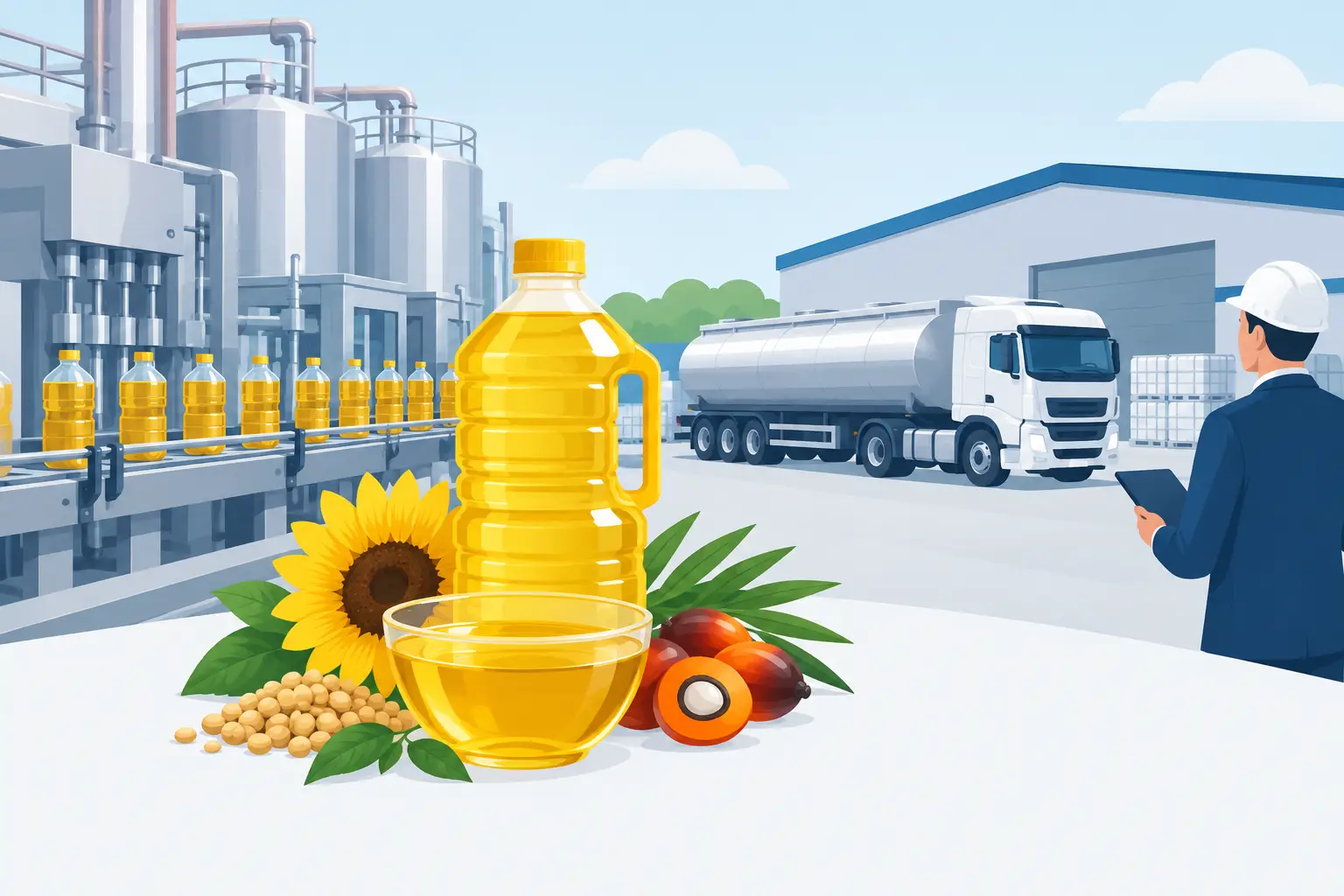
A food factory oil supply example is most useful when it reflects the decisions a procurement team actually has to make: which oil grade fits the process, how much volume is needed, what documentation must accompany each shipment, and where supply risk sits. For a factory, edible oil is not a generic purchasing line. It affects formulation consistency, production scheduling, storage capacity, finished-product quality, and working capital.
Consider a mid-sized food manufacturer producing snack foods, bakery products, and prepared foods for regional distribution. The plant uses refined sunflower oil for frying and general processing, with an expected annual requirement of 2,400 metric tons. Rather than treating the requirement as one annual purchase, the buyer structures it around measurable operating needs.
Food Factory Oil Supply Example: The Operating Requirement
The factory estimates average consumption at 200 metric tons per month. Demand rises during promotional periods and before major holidays, so monthly use can reach 260 metric tons. Its on-site tank capacity is 140 metric tons, enough for roughly three weeks at average production. That storage limit immediately shapes the supply plan: a supplier may have the annual capacity, but must also be able to deliver the right parcel size at the right interval.
The buyer establishes a base program of four truck or container-equivalent deliveries per month, adjusted to the plant's location and receiving capability. Each delivery must arrive within an agreed delivery window because late oil can stop a frying line, while early arrivals may exceed tank capacity. The annual volume is therefore a planning reference, not a substitute for a delivery schedule.
A workable request for quotation should state the following in operational terms: refined sunflower oil, intended food application, estimated annual volume of 2,400 metric tons, monthly forecast range of 180 to 260 metric tons, shipment format, destination, preferred delivery frequency, and required documents. This gives producers and suppliers enough information to quote realistically rather than offer a nominal price that does not match the factory's logistics.
Start With the Oil Specification, Not the Lowest Quote
For edible oil purchasing, the factory's specification is the control point. The procurement team should align it with the technical requirements of production, quality assurance procedures, and customer commitments. A general description such as “sunflower oil” is too broad for contract buying.
The specification may define refined, deodorized sunflower oil; maximum free fatty acid level; peroxide value; moisture and volatile matter; color; odor and taste; impurity limits; and packaging or bulk-tank requirements. The exact limits depend on the application and the factory's internal standards. Frying use, for example, may require particular attention to performance over repeated heat exposure, while a cold-use application may prioritize neutral sensory characteristics and appearance.
The buyer should also establish how conformity will be verified. A certificate of analysis for each lot is standard practice, but the factory may also retain a sample, perform incoming checks, or use an independent laboratory for defined parameters. The contract should identify which specification controls if the purchase order, technical sheet, and certificate use different wording. Small gaps in language can become expensive disputes after material has arrived.
Price still matters, but price comparisons only work when the product basis is the same. A lower offer may reflect a different delivery term, packaging format, quality range, payment condition, or excluded cost. Procurement should compare the landed cost of oil that meets the required specification and reaches the plant in usable condition.
Build Volume Flexibility Into the Agreement
The 2,400-metric-ton annual estimate should not force the factory into inflexible monthly withdrawals. Production plans change. A customer may reduce orders, a product launch may increase demand, or maintenance may temporarily lower oil consumption. The supply agreement should distinguish between a committed base volume and a forecast.
For this example, the buyer may commit to 200 metric tons per month with a tolerance of plus or minus 15 percent, provided forecast changes are communicated before a defined cutoff date. The supplier receives a reasonable production and logistics signal; the factory retains room to respond to commercial variation. The appropriate tolerance depends on market conditions, lead times, and the supplier's available inventory or production planning.
It is also useful to set a call-off procedure. The factory can issue a rolling eight-week forecast, with the first two weeks treated as firm and the remaining weeks as planning estimates. This approach is more practical than relying on one static annual schedule. It helps a producer allocate capacity, source packaging, plan loading, and organize transport while giving the buyer visibility over its own commitments.
The factory should avoid building its entire program around minimum inventory. Lean stock reduces carrying cost, but it also leaves little room for port delays, weather disruption, carrier shortages, inspection holds, or changes in production demand. A defined safety-stock target is usually more valuable than an optimistic delivery assumption. The right level depends on transit time, route reliability, tank capacity, and the availability of alternative supply.
Documentation Is Part of the Delivered Product
For international edible oil supply, documentation is not an administrative afterthought. Missing or inconsistent paperwork can delay customs clearance, prevent receiving, or create traceability problems inside the factory. The document package must fit the destination market, contract terms, and product category.
In this food factory oil supply example, the buyer requests a commercial invoice, packing list or bulk loading information, certificate of analysis, certificate of origin where applicable, transport document, and any food-safety or regulatory documents required for import and customer approval. The procurement and quality teams should agree on the exact list before the first shipment, including whether originals, electronic copies, or pre-shipment document review are required.
Lot identification must connect the supplier's production records to the shipping documents and the factory's receiving records. If an issue is identified after production, the buyer needs to know which inbound lots were used in which finished batches. Traceability is a routine supply requirement, not merely a response to a quality incident.
Document review should happen before goods reach the plant. A practical process is for the supplier to send draft documents for confirmation, allowing corrections before the cargo is dispatched or presented for clearance. This protects both sides from avoidable delays caused by a wrong consignee name, inconsistent quantities, incorrect product description, or absent lot reference.
Define Delivery, Transfer of Risk, and Claims Clearly
A supply contract should state the agreed delivery term, point of risk transfer, shipment mode, unloading responsibilities, and receiving procedure. These details influence the real cost and accountability of each delivery. Bulk road delivery may suit a domestic plant with appropriate tank access. Flexitanks, drums, intermediate bulk containers, or ocean bulk options may fit other routes and volumes. Each format has trade-offs in freight cost, handling, sanitation control, storage, and disposal.
At receiving, the factory should inspect seals, packaging condition or tanker cleanliness, quantity, temperature where relevant, and documents before unloading. Sampling procedures should be agreed in advance. If a claim is necessary, timing matters: visible transport damage may be documented immediately, while a laboratory-quality claim may require retained samples and a defined testing method.
The agreement should describe the notification period and the evidence required for a claim. It should also state the remedy, whether replacement, credit, price adjustment, or another agreed solution. Vague claims language creates friction precisely when production teams need a fast decision.
Assess the Supplier as a Producer, Not Only as a Seller
A food manufacturer needs confidence that its counterparty can perform beyond the first shipment. The assessment should cover production capability, product specialization, quality management, export experience where relevant, documentation discipline, and communication during exceptions. For a recurring oil program, the ability to provide accurate loading dates and early notice of constraints is commercially significant.
Origin also matters. Ukraine remains closely associated with sunflower cultivation and edible oil production, which can support direct producer sourcing for buyers seeking category depth. At the same time, buyers should evaluate route options, transit conditions, insurance, and contingency plans based on the current operating environment. Origin is a commercial strength when paired with realistic logistics planning.
EKOBIOTEK, a Kherson-based Ukrainian producer operating since 2003, represents the type of specialized manufacturing profile buyers may evaluate for sunflower and other vegetable oil supply. The relevant question is not whether a supplier makes a broad promise. It is whether its production experience, specifications, documentation, and delivery plan fit the factory's actual requirement.
Turn the Example Into a Purchase Decision
Before issuing a purchase order, the procurement team should test the program against a simple question: can this supplier deliver conforming oil in the required quantity, format, and time window without creating unacceptable inventory or transit risk? The answer should be supported by the product specification, forecast process, document list, delivery terms, and claims procedure.
For the factory in this example, a sound decision is not simply an annual contract for 2,400 metric tons. It is a managed supply arrangement with monthly call-offs, defined quality controls, traceable lots, realistic safety stock, and agreed responses to disruption. That level of clarity gives the production team something more useful than a competitive quote: a supply program it can run.