
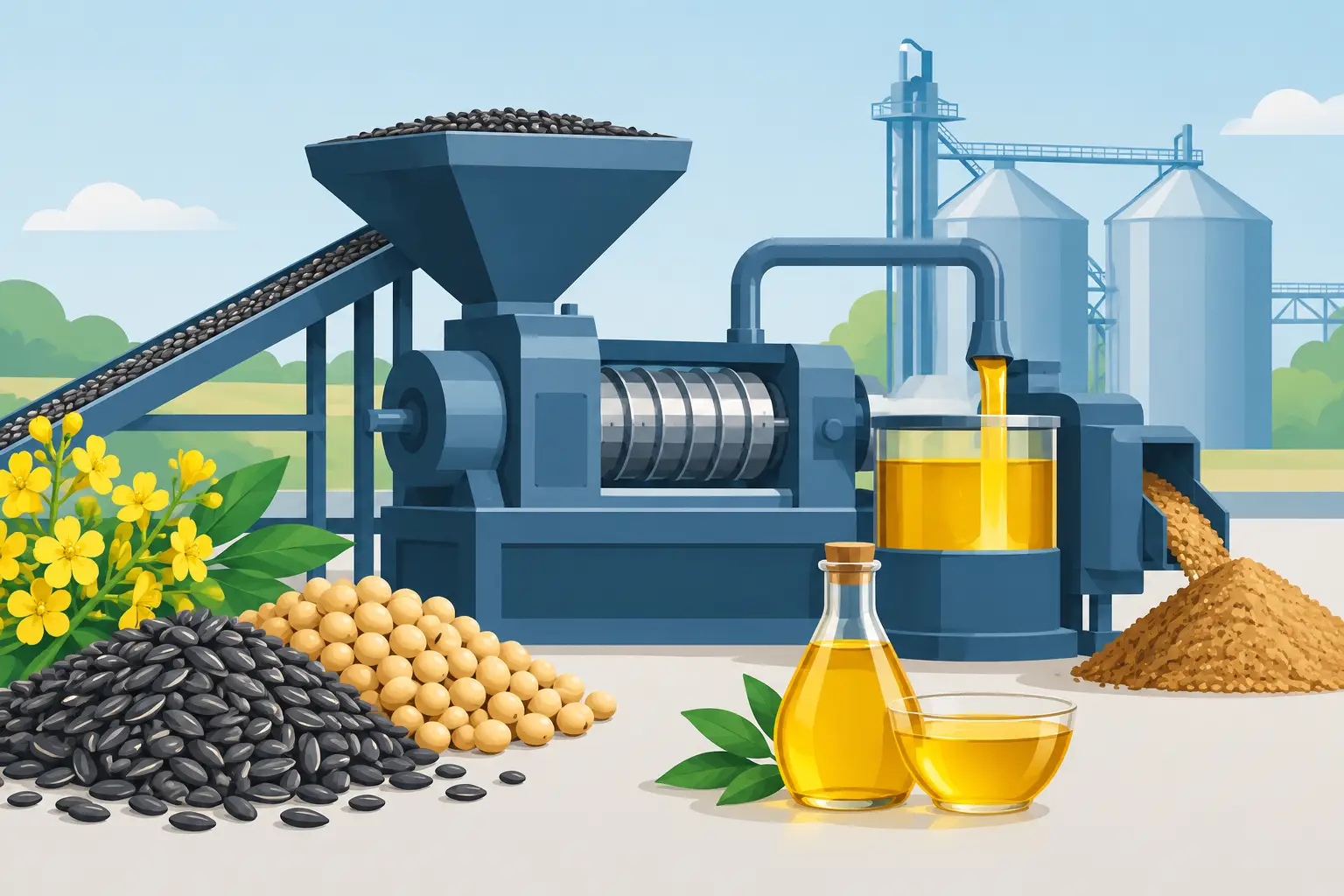
For commercial buyers, a guide to oilseed crushing is not primarily about processing theory. It is a way to assess whether an oil supplier can convert agricultural raw material into consistent oil and meal outputs, manage variation, and meet agreed specifications across repeated shipments. The crushing process affects yield, product quality, logistics, traceability, and ultimately the cost structure of an edible oil contract.
What Oilseed Crushing Produces
Oilseed crushing separates oil-bearing material into two principal streams: crude vegetable oil and solid meal or cake. The exact balance depends on the seed type, its condition, and the extraction method. Sunflower seed, soybean, rapeseed, canola, flaxseed, and other oilseeds each have different oil contents, hull characteristics, protein profiles, and processing requirements.
Crude oil can be sold for further refining or processed into refined, bleached, and deodorized oil for food applications. The solid fraction may be used in animal feed, subject to its protein, fiber, moisture, residual oil, and applicable regulatory requirements. A crusher therefore manages two revenue streams, not one. Buyers evaluating a producer should understand how both are handled because meal economics can influence crushing margins and production decisions.
For sunflower oil suppliers, seed origin is especially relevant. Ukraine remains a major sunflower-growing country, and a processor located close to production areas can benefit from established collection networks and shorter inbound transport routes. That advantage still depends on disciplined procurement, storage, and quality control at the facility level.
Guide to Oilseed Crushing: The Main Processing Stages
The basic production sequence is straightforward, but each stage creates variables that affect commercial results. Seed reception begins with sampling and testing. Processors typically check moisture, foreign material, damaged kernels, infestation, odor, and oil content. A load that appears acceptable visually can still create losses if moisture is high or if the seed has deteriorated during storage.
Cleaning and preparation
Before extraction, seeds are cleaned to remove dust, stones, metal, stalks, and other foreign material. Magnets, screens, aspiration systems, and destoners protect downstream equipment and reduce contamination risks. For some seeds, dehulling is used to reduce fiber in the meal and improve processing efficiency. In sunflower crushing, hull content has a material effect on meal quality and the mass balance of the operation.
Prepared seed is commonly cracked, conditioned with controlled heat and moisture, and flaked. Flaking opens the cellular structure and creates a more uniform material for oil release. Excessive heat can affect oil quality and protein properties, while insufficient conditioning can reduce extraction efficiency. The preferred settings depend on seed variety, moisture level, equipment design, and the intended product specification.
Mechanical pressing and solvent extraction
Mechanical pressing uses expellers to force oil from prepared seed under pressure. It is a practical method for many operations and can produce press oil with relatively simple equipment. However, pressed cake generally retains more oil than material that has undergone solvent extraction. This can be acceptable where the processor values a higher-oil cake or operates at a scale where solvent infrastructure is not justified.
Solvent extraction, often using food-industry-approved hydrocarbon solvents in controlled closed systems, removes additional oil from flakes or press cake. It generally achieves higher oil recovery and lower residual oil in meal. The trade-off is greater capital cost, more complex safety management, energy use, solvent recovery requirements, and stricter operating controls.
Many large-scale facilities use pre-press followed by solvent extraction. This approach can improve overall yield while maintaining high throughput. It is not automatically the correct method for every supplier or buyer. Procurement teams should focus on the output they require: crude or refined oil quality, volume consistency, certification needs, and the supplier's ability to maintain specifications.
Oil clarification and refining
Freshly extracted crude oil contains suspended solids, phospholipids, free fatty acids, pigments, waxes, odor compounds, and trace impurities. Clarification removes insoluble material through settling, filtration, or centrifugation. The resulting crude oil may be traded as such, but food manufacturers and retail supply chains commonly require further refining.
Refining can include degumming, neutralization or physical refining, bleaching, winterization or dewaxing, and deodorization. The required sequence depends on the oilseed and final application. For sunflower oil, winterization is often important because naturally occurring waxes can create haze at lower temperatures. A clear appearance in the final oil is not merely cosmetic when products will be stored or displayed in cooler conditions.
Every refining step has a yield impact. More intensive processing may improve color, flavor neutrality, stability, and appearance, but it also creates losses and can affect cost. Buyers should align specifications with actual end use rather than request unnecessarily restrictive parameters that add cost without delivering practical value.
The Quality Factors That Matter Most
Oilseed crushing begins before the seed reaches the plant. Seed quality sets the operating range for the entire process. High moisture can increase spoilage risk and complicate storage. Foreign material reduces usable throughput. Damaged or poorly stored seed may have elevated free fatty acids, off-odors, or oxidation products that cannot always be corrected economically during refining.
For buyers of vegetable oil, the critical specifications usually include free fatty acid level, peroxide value, moisture and volatile matter, insoluble impurities, color, odor, fatty acid profile, and contaminant limits. The appropriate specification depends on whether the product is crude, refined, winterized, deodorized, or intended for a particular food application.
Documentation matters as much as a single certificate of analysis. A reliable supplier should be able to show a repeatable quality-control process from raw seed intake through finished-product loading. That includes representative sampling, retained samples, laboratory testing, lot identification, tank management, and procedures for handling nonconforming material.
Yield Is a Commercial Measure, Not a Fixed Number
Oil yield is often discussed as if it were a single number. In practice, it changes with seed variety, season, growing conditions, moisture, hull content, cleaning losses, extraction method, and refining losses. Two loads of the same crop can produce materially different results.
A useful commercial question is whether the supplier understands and manages its mass balance. The facility should be able to account for incoming seed, impurities removed during cleaning, oil produced, meal or cake produced, hulls where applicable, process losses, and inventory changes. This discipline supports better planning and makes unexplained variation easier to identify.
Higher extraction is generally desirable, but it should not be considered in isolation. Pushing equipment too aggressively can increase wear, affect meal quality, raise energy consumption, or create quality instability. The best operating point is the one that delivers reliable output within specification at a sustainable cost.
What Buyers Should Verify Before Contracting
A crushing supplier should be evaluated as a production partner, not only as a price quotation. Buyers should verify four operating areas before placing significant volume:
- Raw material sourcing capacity, seasonal procurement planning, and storage practices.
- Processing configuration, including whether oil is pressed, solvent extracted, refined, winterized, or deodorized on site.
- Quality systems covering laboratory methods, traceability, sampling, certificates of analysis, and complaint handling.
- Loading capability, tank storage, packaging format, export documentation, and contingency planning for delays.
It is also reasonable to ask how specifications are controlled between production and shipment. Tank segregation is particularly important where buyers require defined product grades, non-GMO status where applicable, or specific allergen and cross-contact controls. A compliant production run does not protect the buyer if product is later mixed, misidentified, or loaded from an unsuitable tank.
Commercial terms should reflect the physical realities of oil production. The contract should define product grade, tolerances, test methods, sampling point, quantity basis, packing or bulk loading requirements, delivery terms, and the process for resolving quality claims. Ambiguous language creates unnecessary disputes when market prices or logistics conditions change.
Storage and Transport After Crushing
Oil quality can decline after processing if storage is poorly managed. Exposure to oxygen, light, elevated temperature, moisture, or residues from previous cargoes can affect flavor, color, and oxidative stability. Storage tanks, transfer lines, filters, and loading equipment must be cleaned and maintained according to the product grade being handled.
For bulk exports, buyers should confirm the tank and vessel or flexitank requirements appropriate to the shipment. Temperature management may also matter, especially for oils that can cloud or crystallize during cold transit. The objective is not simply to move oil from plant to destination. It is to deliver oil that still meets specification when it is sampled at the agreed contractual point.
EKOBIOTEK approaches vegetable oil production from this manufacturing perspective: consistent raw material handling, controlled processing, and supply readiness for commercial buyers. For importers and food manufacturers, the most useful supplier discussion starts with the required specification and ends with evidence that the production and logistics system can maintain it shipment after shipment.