
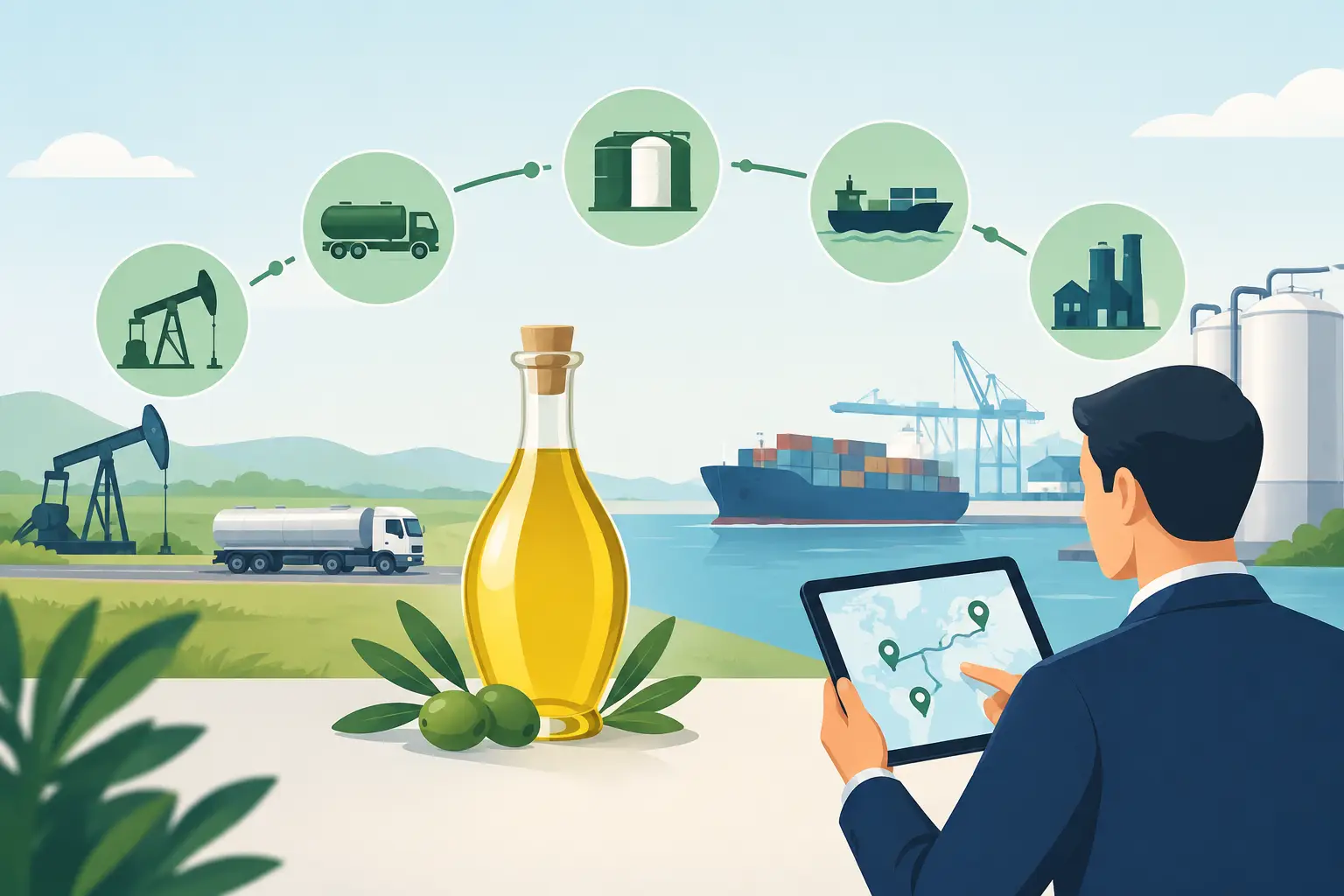
A shipment of sunflower oil can meet an agreed specification and still create a procurement problem if its origin, production batch, or handling history cannot be verified. This oil traceability guide is intended for commercial buyers who need documented control from raw material intake through processing, storage, loading, and delivery.
For importers, food manufacturers, distributors, and private-label buyers, traceability is not a marketing claim. It is a practical method for approving suppliers, investigating deviations, managing recalls, and protecting continuity of supply. The level of detail required depends on the product, destination market, contract terms, and intended use. However, every edible oil buyer should be able to establish a clear chain between the delivered lot and the records behind it.
What Oil Traceability Means in Commercial Supply
Oil traceability is the ability to identify the history and movement of a specific product lot. For vegetable oils, this normally connects the finished oil to production records, incoming raw materials, quality-control results, storage tanks, and shipping documents.
A traceable system answers two questions. First, where did this particular oil lot come from? Second, where did every portion of that lot go after it left the facility? Both directions matter. Backward traceability supports root-cause investigation. Forward traceability supports customer notification, shipment isolation, and recall execution if a quality or food-safety concern is identified.
Traceability does not mean that every bottle or bulk container can be tied to a single farm. In large-scale edible oil production, raw materials from multiple approved sources may be processed together. The practical requirement is to maintain controlled lot relationships and accurate records of each material movement. The buyer should understand the supplier's lot definition and whether the finished oil represents a single production run, a tank blend, or a loading batch.
The Records That Should Follow Each Lot
A supplier should be able to provide or retrieve a consistent document set for every commercial lot. The format may be paper-based, digital, or a combination, but records must be legible, controlled, and retained for an agreed period.
At minimum, buyers should expect a lot or batch number that appears consistently on the certificate of analysis, packing list, invoice, and transport documentation. A certificate of analysis should identify the product and lot, state the relevant analytical results, and show that the product was released against the agreed specification. Typical parameters for sunflower oil may include moisture and volatile matter, insoluble impurities, acid value or free fatty acids, peroxide value, color, odor, and other contract-specific requirements.
Production records should show the processing date or period, production line where applicable, tank numbers, filtration or refining stages, and quality-release authorization. Storage records should identify the tank or warehouse location, transfers between tanks, and cleaning status where this is relevant to the product and customer requirements.
For bulk shipments, loading records are especially valuable. They should connect the lot to the loading date, vehicle or container identification, seal numbers when used, net weight, and destination. For flexitanks, drums, IBCs, or packaged product, the buyer should also confirm that packaging codes and pallet or container references can be reconciled with the shipping documents.
Start With an Agreed Lot Definition
Many traceability gaps begin before production because the buyer and supplier use the word “batch” differently. One party may mean a day's production, while another may mean all oil stored in a specific tank before loading. Neither approach is automatically wrong, but the definition must be clear.
A procurement specification should state how a lot will be identified and what documents will apply to it. If several production batches are blended into one export tank, the supplier should be able to show the contributing batches and the final tank release record. If one production batch is divided among several trucks or containers, every outgoing shipment should retain a reference to that original batch.
This becomes more significant when a buyer uses oil in a regulated food product or supplies multiple downstream customers. A broad lot definition may reduce administrative workload, but it can expand the volume affected by an investigation. A narrower definition provides more precise control, though it requires stronger discipline in tank management, sampling, labeling, and documentation.
Verify Traceability Before the First Shipment
Traceability should be assessed during supplier qualification, not after a claim or rejected delivery. Buyers can request a sample traceability exercise based on a finished lot number. The supplier should be able to work backward to production and incoming materials, then forward to all customers or shipments that received related product.
The exercise does not need to expose confidential supplier relationships or unnecessary commercial data. Its purpose is to confirm that records are linked, available, and usable. A credible response identifies the lot, document references, relevant dates, quantities, storage locations, and shipping destinations within a reasonable time.
During approval, buyers should also examine how the supplier prevents errors in labeling and document release. A lot number has limited value if it can be copied incorrectly onto a certificate or shipping document. Controlled templates, authorization steps, tank identification, calibrated weighing equipment, and retained samples all support the reliability of the traceability system.
For international procurement, make sure the commercial documentation uses matching descriptions. Differences in product name, grade, net weight, lot number, or consignee details between the certificate of analysis, invoice, packing list, and bill of lading can delay customs clearance and complicate later verification. These errors are often administrative, but they should be resolved before shipment release whenever possible.
Link Traceability to Quality Control
Traceability and quality assurance are related, but they are not the same. A certificate of analysis confirms measured results for a lot. Traceability explains how that lot was produced, stored, and shipped. Buyers need both.
A sound control process begins with approved raw materials and continues through receiving inspection, processing, in-process checks, finished-product testing, storage, and loading. Records should show when a result falls outside the internal target or customer specification and what disposition was made. Rework, blending, reprocessing, and product holds require particular attention because they can create complex lot relationships.
Retained samples provide an additional safeguard. The supplier should maintain samples that represent the released lot under suitable storage conditions and for an agreed retention period. If a dispute arises over odor, color, sediment, oxidation, or another quality characteristic, a retained sample may help establish whether the issue originated before shipment, during transport, or after delivery.
For crude, refined, winterized, deodorized, or high-oleic sunflower oil, the traceability file should reflect the specific grade supplied. Buyers should not assume that one set of controls applies identically to all products. Product specifications, processing steps, and testing requirements vary by grade and end use.
Manage Storage, Transport, and Chain-of-Custody Risks
The oil's documented history must continue after processing. A correctly produced lot can be compromised by an unsuitable tank, inadequate cleaning, misrouting, or an incorrect loading connection. Traceability records should therefore include the storage and transport chain, not only the production stage.
Before loading, the supplier should verify the identity and condition of the designated tank or transport unit. For bulk edible oil, buyers may require evidence of previous cargo acceptability, cleaning procedures, inspection status, and seal control. The appropriate requirements depend on the transport mode and contractual terms, but the control objective remains the same: prevent contamination, mixing, and loss of lot identity.
Temperature records may also be relevant, particularly where transit conditions can affect handling, appearance, or crystallization. Temperature alone does not prove product quality, but it can assist an investigation when paired with loading records, arrival inspection, and sample results.
Ukraine remains a major origin for sunflower seed and sunflower oil. For buyers sourcing from Ukrainian producers, origin records, processing-site identification, and export documentation should be reviewed as part of the normal procurement process. EKOBIOTEK applies a production-focused approach to documenting oil lots from processing through commercial dispatch, supporting buyers who require clear product identification and consistent supply records.
Use Traceability When Something Goes Wrong
The value of traceability is tested when a shipment is questioned. A buyer may receive oil with an unexpected analytical result, damaged seals, a documentation discrepancy, or a sensory concern. The first action should be to isolate the affected lot and preserve all related records, samples, photos, and transport details.
The supplier and buyer should then work from the same lot number and shipment references. A structured review normally covers the certificate of analysis, retained-sample status, production and tank records, loading details, seal information, transport timeline, and receiving inspection. Conclusions should distinguish verified facts from assumptions. This reduces the risk of assigning responsibility before the evidence is complete.
A supplier's response time matters, but speed without record accuracy is not enough. Buyers should establish escalation contacts and expected response windows in advance, especially for high-volume or business-critical programs. The goal is not only to close one incident. It is to identify whether a process, document-control, storage, or carrier-management change is needed before the next shipment.
Clear traceability gives commercial buyers a practical basis for confidence. Ask for records that match the way oil is actually produced, stored, and shipped, then test the system before supply becomes critical. A supplier that can account for each lot with disciplined documentation is better positioned to support reliable long-term trade.