
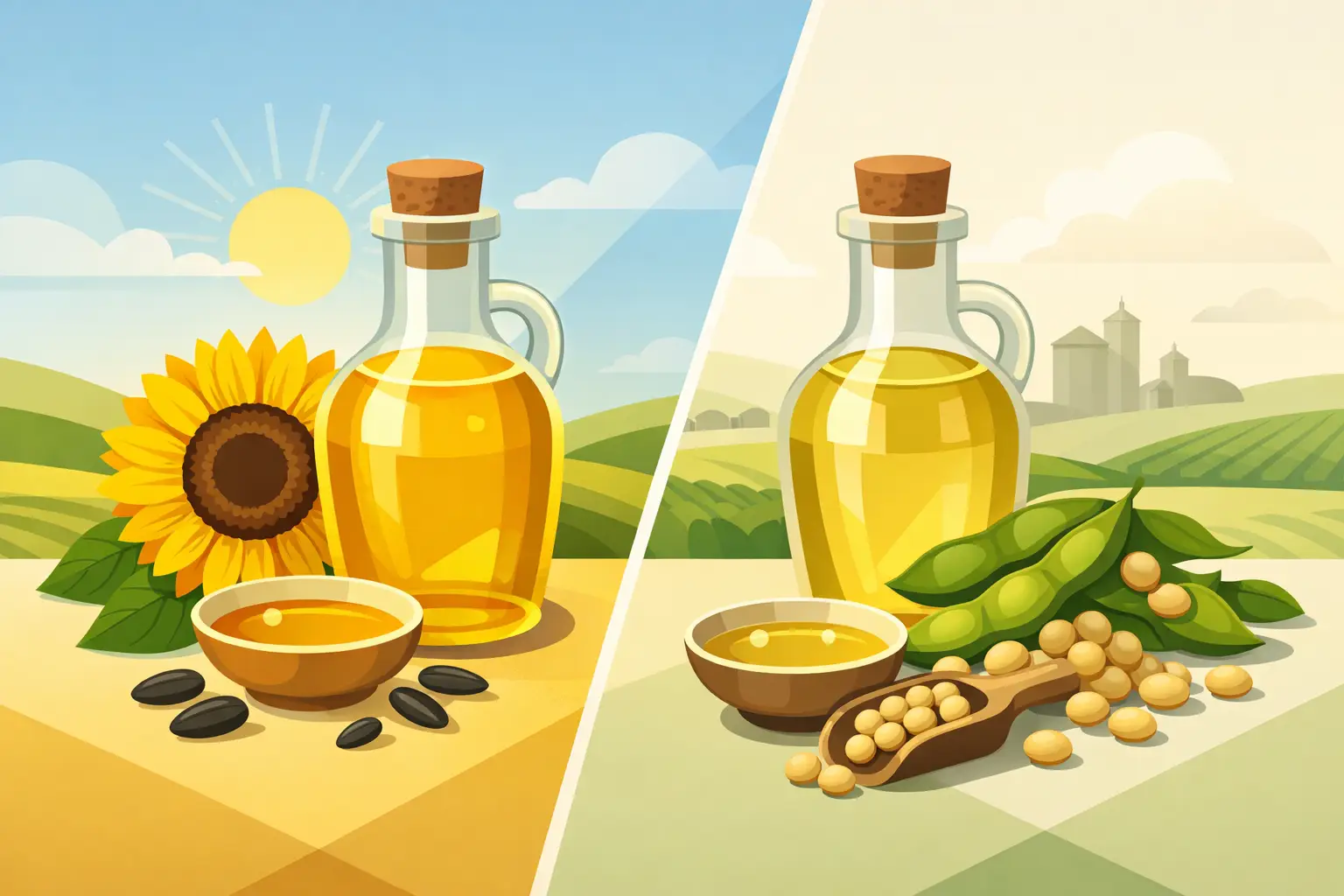
For commercial users, sunflower oil vs soybean oil is not a simple question of one oil being better than the other. The appropriate choice depends on the finished product, processing conditions, label requirements, target market, cost structure, and supply strategy. Both are widely used edible oils, but their fatty-acid composition and commercial characteristics lead to different results in frying, baking, sauces, margarine, and industrial food production.
A procurement decision should begin with the required specification, not with a generic product preference. Buyers should define the oil type, refining standard, packaging format, origin requirements, shelf-life expectations, and technical performance needed for the application.
Sunflower Oil vs Soybean Oil: Core Differences
Conventional sunflower oil is generally valued for its light color, neutral flavor, and high level of unsaturated fats. Depending on the seed variety, sunflower oil may have a high linoleic or high oleic fatty-acid profile. High-oleic sunflower oil is specifically selected for greater oxidative stability, making it suitable for applications involving extended heating or longer shelf life.
Soybean oil is one of the most widely traded vegetable oils globally. It has a balanced commercial profile: broad availability, established processing infrastructure, and use across a large range of food applications. Conventional soybean oil contains more polyunsaturated fatty acids than high-oleic sunflower oil, including alpha-linolenic acid, an omega-3 fatty acid. This composition can be beneficial nutritionally, but it may also make the oil more susceptible to oxidation under demanding heat exposure.
For buyers, the central distinction is practical. Standard sunflower oil, high-oleic sunflower oil, and soybean oil should be treated as separate sourcing options with different performance profiles. A product specification must identify the exact oil grade rather than relying only on the broad category name.
Fatty-Acid Profile and Product Stability
Fatty-acid composition affects how an oil performs during storage, heating, and incorporation into food products. Oils with higher oleic acid content typically offer improved resistance to oxidation compared with oils higher in polyunsaturated fats. This is why high-oleic sunflower oil is frequently considered for frying, snack production, and other applications where stability is a priority.
Conventional sunflower oil is commonly high in linoleic acid, an omega-6 polyunsaturated fat. It remains suitable for many food uses, particularly where neutral taste, appearance, and general-purpose performance are required. However, its stability profile differs from high-oleic sunflower oil.
Soybean oil is also rich in polyunsaturated fats. In some applications, manufacturers may use soybean oil directly; in others, they may choose high-oleic soybean oil, blends, or further processing to reach a desired stability level. The practical question is not whether polyunsaturated oil is acceptable. It is whether the formulation, production process, packaging, and intended shelf life can support the selected oil.
Refining quality also matters. Properly refined, bleached, and deodorized oil is expected to meet commercial requirements for color, odor, flavor, moisture, impurities, and stability. Buyers should evaluate documented specifications and lot consistency alongside the oil's natural fatty-acid profile.
Frying, Baking, and Food Manufacturing Use
For frying operations, oil performance is determined by more than smoke point. Repeated heating, turnover rate, food moisture, filtration, fryer design, and the presence of oxygen all affect oil degradation. High-oleic sunflower oil is often selected where extended fry life and a neutral flavor profile are required. Its suitability is especially relevant for snack foods, quick-service frying, and industrial operations that seek to control off-flavors and reduce oil replacement frequency.
Soybean oil can also be used in frying and food manufacturing, particularly where supply availability and cost position support the formulation. Its use may be more appropriate in applications with shorter heating cycles, controlled production conditions, or oil blends designed for specific functionality.
In baking, both oils can provide moisture and texture without a strong flavor contribution. The right choice depends on product development requirements. Sunflower oil may support a cleaner sensory profile in products where flavor neutrality is essential. Soybean oil may be a practical option for high-volume formulations where an established, broadly available commodity oil is needed.
For dressings, sauces, mayonnaise, and emulsified products, the choice should account for flavor, cold stability, formulation behavior, and label positioning. Testing under actual production conditions remains necessary. A laboratory fatty-acid profile provides useful direction, but it does not replace validation in the finished product.
Nutrition and Label Considerations
Both sunflower and soybean oils are primarily unsaturated fats and are naturally cholesterol-free. Their nutritional differences are mainly related to the balance of fatty acids and the form of the oil being purchased.
Sunflower oil is often associated with vitamin E content and, in high-oleic grades, a higher proportion of monounsaturated fat. Soybean oil provides a mix of omega-6 and omega-3 fatty acids. These characteristics may influence nutrition panel calculations and product positioning, but food manufacturers should review applicable US labeling rules and confirm values against supplier documentation.
Soy is a major allergen under US food labeling requirements. Highly refined soybean oil is generally treated differently from soy protein in allergen labeling, but manufacturers should verify the regulatory status of their specific ingredient and finished product. This is particularly relevant for private-label programs, export products, and facilities with strict allergen-management procedures.
Claims should never be based only on the oil category. Any nutrition, fatty-acid, non-GMO, organic, allergen, or origin claim requires supporting documentation and review against the requirements of the destination market.
Supply, Origin, and Commercial Risk
Soybean oil benefits from a large global production base, with major supply linked to soybean processing in the Americas and other producing regions. Its broad commodity market can provide purchasing flexibility, but prices are influenced by soybean harvests, crushing economics, meal demand, biofuel demand, freight, and trade policy.
Sunflower oil supply is strongly connected to Black Sea and Eastern European agricultural production, as well as other sunflower-growing regions. Ukraine has long been a major center of sunflower cultivation and oil processing. For buyers seeking sunflower oil, origin can be a meaningful factor in both commercial planning and supplier assessment.
Supply continuity should not be judged by origin alone. Buyers should review production capacity, raw-material access, storage capability, export readiness, quality systems, packaging options, and communication reliability. An experienced producer can provide more useful commercial confidence than a trader offering an unspecified source.
EKOBIOTEK operates as a Ukrainian producer focused on sunflower oil and vegetable oils, with manufacturing experience dating to 2003. For B2B buyers, producer identity and direct knowledge of the product category can support clearer specification discussions and more dependable supply planning.
What to Request From an Oil Supplier
Before approving either oil, procurement and quality teams should request a current product specification, certificate of analysis, fatty-acid profile, refining description, shelf-life information, packaging details, and storage recommendations. If the oil will be used in a regulated or claim-sensitive product, supporting statements for allergens, GMO status, origin, contaminants, and applicable certifications should also be confirmed.
Commercial terms require equal attention. Minimum order quantity, available packaging, loading method, lead time, Incoterms, payment conditions, and port or destination capability affect the delivered cost as much as the quoted oil price. Bulk buyers should also establish acceptable tolerances for quality parameters and a clear process for pre-shipment approval and claims handling.
Selecting the Right Oil for the Application
High-oleic sunflower oil is often the stronger option when oxidative stability, extended frying performance, and neutral flavor are primary requirements. Conventional sunflower oil can be a suitable general-purpose choice when the formulation does not require the added stability of high-oleic grades.
Soybean oil may be the right fit when broad market availability, established use in a specific formulation, or a competitive commodity position drives the buying decision. It can also be appropriate in blends where its characteristics complement other oils.
The most useful purchasing decision is the one tied to a defined application and verified specification. When performance, documentation, and supply capability are evaluated together, sunflower oil and soybean oil become manageable sourcing choices rather than interchangeable commodities.